Monday, December 3, 2012

Dear PM Advisor December 3, 2012

Dear PM Advisor,

I was planning my project and had been told when certain deliverables were due in the future. So I started with when those tasks were due and back-scheduled from there. When the Project Manager looked at these tasks he blanched and told me I had done it wrong. Can you explain? I enclose the Gantt chart.

Backwards in Corning, NY

Dear Backwards,

Many years ago I took an advanced MS-Project class and one of the key messages I took from here was to watch out for the little calendar icons that show up in the Indicators column. Your Gantt chart is full of them. I didn't want to expose any of your secrets so I opened up one of the basic deliverables:

Notice those icons in the left-most column? Those are your red flags. They show up when you type dates into your start or finish column rather than link up your tasks. What they indicate is that this task can start no earlier than or finish no later than a certain date. The problem with this is that when things previous to this task changes, (as it almost certainly will) this task will not move. Watch when I decrease the duration of a task within this group:
Notice that while task 24 finishes now on 5/10, the subsequent task still is planned to start on 5/15. That is because you told MS-Project that it cannot start any earlier than 5/15.

Now this may be a reality, if the task is connected to a fixed outside date, for example, but this is usually a rare event. So treat these icons like the red flags they are.

How do you fix this Gantt chart? It's actually pretty easy. Select all the tasks where you have this problem, then open up the task information window. Press the Advanced tab, click on the constraint pull-down menu and select As Soon As Possible.
Good luck,

PM Advisor

Send me your questions at bfieggen@gmail.com

Saturday, December 1, 2012

Wednesday, November 28, 2012

Soccer Ball Project


The One World Futbol stays inflated, even when used on concrete in El Salvador.

By Published: November 8, 2012

A few years back I was impressed when the winner of the third season of Survivor, Ethan, used his money to provide soccer balls for kids in needy countries. I had heard that these kids used bags full of trash in place of the real thing and was happy to know that some kids were getting the real thing.

Recently, reading this NY Times article, I found that those balls typically last only 24 hours in the rough conditions of third world neighborhoods. The ground and walls are too rough on inflated leather.

Mr. Jahnigen of Berkeley, California decided to do something about it and found a material called popfoam which would remain durable, providing a ball that could last 30 years. Out of this product he created the oneworld futbal. At first they were expensive to build and cost $40, which allowed you to buy one and donate another to a needy village. Unicef buys 30,000 a year but has to pay $30 each because of the high production costs.

Here's a video about the ball's construction.

They are truly impressive. The article discusses some of the stress tests he put the ball through:
To test the balls’ durability, Mr. Jahnigen sent them to places like Rwanda, where they were used at a camp for former child soldiers. A lion at the Johannesburg Zoo, who would go through six regular balls a day, played with two balls. A German shepherd spent a year biting on a ball. In every case, the balls withstood the abuse.

Still, there was the problem with price and size. They cannot be shipped uninflated. But recently, Chevrolet commissioned 1.5 million balls to be donated. Here's a plug for this worthy cause:

Monday, November 26, 2012

Dear PM Advisor, November 26, 2012

Dear PM Advisor,

My solution to the many project demands on my time has been to heavily multitask. Yet I seem to fall further and further behind. What am I doing wrong?

Running in circles in Princeton, NJ

Dear Running,

Ahh, the evils of multitasking. A few years back I saw a great presentation on this subject and have added it to my repertoir. Let me see if I can reproduce the theory.

Multitasking is a great idea when you cannot go further with one task and move to another rather than wait around until you can continue with the first task. Or if the two tasks do not interfere, like listening to books on CD while driving to work and back.

Where multitasking falls apart is when people have to stop one task to start another. Like when completing tasks on projects.

Take our typical poor team member who is working on three projects and is responsible for several tasks on each. Every PM wants her to work on his tasks first so they harass the team member operating on the squeaky wheel gets oiled theory. Teh Team member responds by dropping one task to work on the other until a new PM comes by griping. Let's look at this situation graphically.

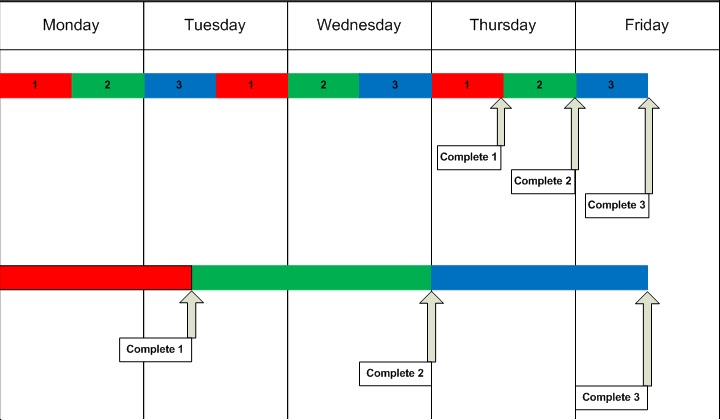
I'll even make it less complex by assuming each PM only needs one task completed this week. (Wouldn't that be nice?) So our team member promised each PM to complete the tasks in a couple of days, knowing each should only take a day and a half. Left to her own devices, she could complete the tasks like this and leave early on Friday:


Unfortunately, she keeps getting bugged by the PMs and changes her strategy to switch from one task to the other, so that she is able to tell PMs, "I'm 1/3 done with your task, 2/3 done with yours etc."

Look at what this accomplishes, however:


Note that task 1, instead of being complete on Tuesdsay afternoon is now completing on Thursday afternoon. Task 2 goes from Thursday morning to Friday morning and task 3 completes at the same time. We can assume that each task has someone waiting on it to get started on their own task so each one of those tasks has now been delayed. Only task 3 finishes at the same time. This replicates throughout the organization causing massive delays.

But even this is optimistic. There is a lack of efficiency when you drop one task and pick up another. At a minimum you are closing one file, looking for and opening up another then finding your place again. Here's what this looks like:
Now we see that every task loses by multitasking.

We need to change people's attitude from: 'How many tasks have I started?' to 'How many tasks have I finished?' For exactly the same reason as why we want management to change their attitude from: 'How many projects have I started?' to 'How many projects have I finished?' We gain value from finishing tasks, just as we gain value from completing projects.

So what is my practical advice to you? Determine, hopefully from some published project priority list within your organization, which projects are most important to the organization. If no list exists, make up your own priority list. Then determine, by asking the PMs, which tasks you are doing fall on the critical path of each project. Using this information, prioritize your tasks for the week as shown in the top diagram. Then perform the tasks as prioritized. Only switch tasks if you are forced to halt one task by outside forces.

Good luck,

PM Advisor

Send me your questions at bfieggen@gmail.com

Sunday, November 25, 2012

Forty-eighth excerpt from 'Twelve Towers'

Next morning they inspected the site which had been almost cleared by the full team. Fred joined Gwilym and Bleddyn transferring the activities to a calendar. The first thing they did was mark off every Sunday and Holy Day from the calendar they had gotten from Father Drew. Then they wrote down, on each working day, which activities would be worked on that day. When they were done, they found that by following the plan they would be finished two weeks after Beltane.
Gwilym returned his gaze to the network diagram. “There are some activities here that could be sped up by taking men from other activities and putting them to work there.”
“But won’t that only slow down th’activities you take them from?”
“Aye, it will. But look at this.” He pointed out two strings of activities that both led to one common activity. “See how this first set of activities finishes on day 6 but the string below finishes on day 8. That means that this activity cannot start until day 9 because they both have to finish before we can do that one. So if I take men from the short string and add them to the longer one, maybe I can finish both strings in day 7. That will cut 1 day from the end of the project.”
“Where else can tha do that?”
“Let’s find all the places where strings come together and see.
The three identified all these activities of confluence and noted, in each case, which preceding string of activities finished last. Gwilym noted each one with a red dot. In one case he saw that the string he had noted led to an activity that was part of a string that later on was not colored red. That was because a different string leading to that same activity of confluence was longer still. He pointed this out to Fred and Bleddyn.

“There can be only one path that defines the length of the project. Look what happens if we go backwards. We start at the end, come to the first activity of confluence and follow the red dots to the second activity of confluence, then follow the red dots backwards all the way until we get to the start activity. All those other red dots don’t matter. We need to focus on this path. It is the critical path that defines the length of the project.”
“But Da, if you decrease the length of this ‘critical path’ won’t some of these other paths become critical?”
“Good point lad! We’ll have to keep an eye on them. But first, let’s look at the activities on the critical path and see which ones are most likely to be able to be sped up by adding more people.”
They noted some candidates.

When the crew came in for dinner, they asked them how the work was progressing. All the men seemed upbeat and Siorys estimated that they would be done by the end of today. After eating, some men gathered at the network diagram to find their activities. They asked what the red dots meant. Gwilym explained and the men nodded their agreement. “You stone masons always hold up my work,” groused one of the men.
“Our project must be finished by Beltane. The way we have it planned makes it finish two weeks late. We have to find ways to reduce the duration of some of these critical activities. Can we add men who are not being used at this time to these five critical activities to speed them up?”
The men gathered around and talked amongst themselves. “I’ll not be busy during that time,” volunteered one. “Perhaps so, but you’ll gum up the works,” joked another. The men talked it over with Gwilym and agreed that by adding men they could ‘crash’ parts of the project to bring the end date in closer to Beltane.
When the men returned to work, Fred helped Gwilym change the numbers on the network diagram and redo the calendar. This time they were only a day after Beltane.
“That’s all right, then Gwilym. They’re going to finish th’clearing a day early so we’ll be fine.”
“It’s too tight. Something always goes wrong in these projects and I’d like some room to move the project when that happens. We need a safety zone, a buffer. What else can we do?”
Fred studied the network diagram. “Here is a long string of activities that needs to be shortened. Do they all have to go after each other. Couldn’t we move one to the string above?”
“You mean do the activity in parallel instead of in series? Let’s see.”
The two men were joined by Bleddyn staring at the long string of activities.
“Building the stairs is slowing down a lot of activities. We can’t start it until the outside of the tower is built but we can’t do a lot of other activities until the stairs are in place. Can we build them independently of the tower and then move them in later?”
Fred laughed at this, then, seeing Gwilym’s expression, quieted and grew thoughtful. “We couldn’t build th’entire set of stairs outside th’tower but we could build all th’flights outside and then put them together inside. That would save a lot of time.”
Gwilym smiled and said, “Let’s ask the carpenter.”
The carpenter agreed and the new plan predicted them finishing a week before Beltane. Gwilym obtained a new hide and asked Fred to transfer the activities to this new sheet, making a clean copy of the plan they could use to build the tower.
“What do tha call these new tools, Gwilym?” asked Fred as he worked, humming his song.
Gwilym smiled. “What words are easy to rhyme with?”
“I can rhyme wi’ anything. Tell me what you call those tools.”
“Let’s see. First we estimated the duration of each activity, then we placed them in sequence, then we developed the schedule. We used a Network Diagram to visualize the schedule, then placed the activities on a calendar to manage them on a daily basis. Adding resources to an activity to speed it up is ‘Crashing’ and running two activities in series that are usually done in parallel is  ‘Fast-tracking’”
Fred went back to work amusing Gwilym with occasional outbursts of “Network, Get work, Duration, Damnation, Nation, Sequence, Frequents.”


To read the entire first draft in one shot, click here:

Wednesday, November 21, 2012

Inventions from the hurricane

Every disaster spawns inventions and this latest Hurricane was no exception. Those I feature here were in process already, spawned by previous disasters but they will ring true to anyone in New York who recently had to deal with flooding and disrupted subway service.

How about a balloon that opens within a subway tunnel to block the water flow enough to allow any leakage to be pumped out?

 An  inflatable device that could save tunnels from flooding. By  
As shown in this article, this project has been around for a few years with successes and failures but it recently got new life after many of NYC subways were inundated and millions of commuters were shuttled onto ferries and buses.

A bigger potential problem deals with rising sea levels and the fact that Manhattan is barely above current sea levels. How do you protect a whole metropolis?

The Netherlands has been struggling with this problem for its entire existence. Here are the flood gates that close periodically to protect Rotterdam from the ravages of the North Sea:
Tineke Dijkstra/Hollandse Hoogte
London has gates to protect from surges up the Thames:
A flood barrier on the Thames by
Read more in this recent Times article.

Monday, November 19, 2012

Dear PM Advisor November 19, 2012

Dear PM Advisor,

I've been told that while we can use PERT to estimate the duration of an uncertain activity, the reason for the uncertainty doesn't go away. Can you please explain?

Uncertain in Jersey City

Dear Uncertain,

PERT, or Program Evaluation Review Technique, is a nice way to take into account the uncertainties in cost and/or schedule of activities and derive a figure that takes those uncertainties into account. By using the below formula, you end up with a duration (or cost) that is pretty realistic. For this example I'll use duration though the same applies to cost.

Duration = (Optimistic + Pessimistic + 4 x Most Likely)/6

So, take for example a situation on a critical project that will last only a few days where one of the activities is to drive a package to Kennedy airport from your location in Jersey city in the middle of February next year. How long will that take?

Optimistically, 40 minutes. Pessimistically, with snow on the ground at rush hour on a work day, 4 hours. Most likely, 90 minutes. Using the formula, we get:

Duration = (40 + 240 + 4 x 90)/6 = 107 minutes

So, by giving yourself 107 minutes for this activity  you are likely to complete it on time. But you have not removed the underlying uncertainty behind the activity. It may still snow, there may be car accidents or rush hour, all those bad things might still occur.

The only thing you have done is taken statistics into account and provided a duration that should allow you to finish your project on schedule. Not every possible bad thing will happen so, even if it does snow for this activity, some other activity will hit the optimistic duration and you will be back on track.

Good luck,

PM Advisor

Send me your questions at bfieggen@gmail.com