Thursday, May 17, 2012

NYC Bike experiment

After spending millions and aggravating thousands of people creating a network of bicycle lanes in New York City, Mayor Bloomberg announced the unveiling of its own bicycle share program. This third generation program strives to avoid the pitfalls of previous cities' experiments and move NYC into the future of green transportation.

According to this post within Wikipedia, there are over 300 of these bike share programs worldwide and they have gone through three generations.
  1. Free bikes are painted a distinctive color and distributed unlocked for anyone's use. (These programs invariably fail due to theft and vandalism)
  2. A small deposit is paid for the use of the bikes at stations. (Since the deposit is small compared to the value of the bike, these bikes usually fall prey to theft)
  3. The third generation uses credit card deposits, membership within the program and credit card withdrawals that pay for lost or damaged bikes
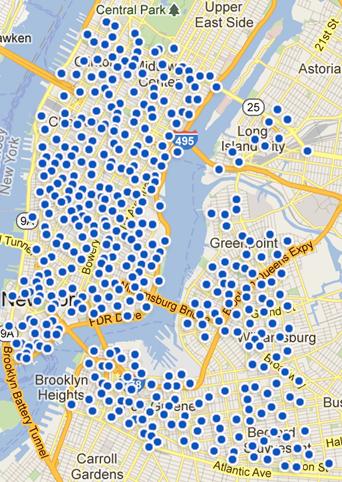
The NYC plan is sponsored by Citibank who, in exchange for advertising on the bikes, kiosks and elsewhere in the city, will pay for the bikes and kiosks and setting things up. This ambitious project will have 600 stations boasting 10,000 bikes, making it the biggest program in the US. Click on this interactive map to see the proposed stations for the first phase.

The locations were picked in concert with the public. http://a841-tfpweb.nyc.gov/bikeshare/station-map/

The system is administered by Alta which runs the Capitol Bike program in Washington DC. It is self-sustaining through use of membership that can be purchased for 24 hours to one year. Riders are only charged if they use the bike for more than 30 minutes and the price moves up steeply from there, encouraging quick turnovers.
Let's hope for the best for this project.

Tuesday, May 15, 2012

What happened to secrecy in war?

So the good news was that we foiled another Al Qaeda bomb plot. Then it became even more exciting when we learned that guy we 'arrested' was actually a double agent the Saudis had infiltrate AQAP.

But why do we know this? Surely this is one of those secrets we should be hearing about in fifty years to protect the agents involved and the ongoing operation? While it's exciting to read about these adventures, I'd rather win the war and read about them later.

So what prompted the disclosure? Was it payback for the last Saudi double-agent we placed there who was executed? Or was it election-year politics?

Sunday, May 13, 2012

Thirty-fifth excerpt from 'Twelve Towers'


Father Drew was following along with his own Bible and nodded his head.
Father Drew was admiring the collection of scrolls in Bleddyn’s library. “You have put your library to good use, son.”
“Aye, Father. Would you like to trade some scrolls for copying again? I found some real interesting ones in Airmyn and Londinium.”
“I certainly would. Show me what you have.”
Father Drew and Bleddyn bent over the collection for a while and the priest picked one out. “I have a great adventure story in my collection that I have been saving for you, son. I will bring it with me tomorrow.”
Bleddyn smiled, sensed his father wanted to talk with the priest alone, and left the room.
Father Drew turned to Gwilym. “How goes your quest, Gwilym?”
Gwilym laughed and said, “You mean the building of towers? It is hardly a quest, though I’ve been learning a lot about how to do it better. Fred is keeping track of the ideas and Bleddyn is teaching him how to read and write. We plan to write down all our improvements in something called ‘The Project Management Guide’”
“That is a lovely story, Gwilym but you are concealing from me your true quest. Why is a man who reads better Greek and Latin than I, a man who has traveled to the Holy Land, a man with a huge collection of scrolls, building towers?”
“It’s a living, father. You cannot feed your family on scraps of Greek.”
Father Drew looked long and hard at Gwilym, then released him from his stare. “Let us resume our talk about the Bible. I have done a lot of studying since we last talked and have a few questions.”
Gwilym nodded.
“Which parts of the Bible do you believe are true and which are not?”
Gwilym took a deep breath and prepared his words. “My father came up with three criteria that help you to decide how likely it was that anything in the past actually happened. If something meets all three criteria, it is more likely to be true than if it meets none of the criteria. I cannot say for sure if it really happened, only that the likelihood is higher.”
“That sounds sensible. What are the criteria, Gwilym?”
“The first is the criterion of multiple attestations. If different people tell the same

Friday, May 11, 2012

Habitat for Humanity stabilizes Property Values

According to this recent Times article, Habitat for Humanity, the Christian charity founded in Georgia in 1976, has been making some smart purchases during this recent housing price turndown. And clever philanthropists are noticing and adding their money to the group's efforts.

In a depressed real estate market, Habitat, the nonprofit housing group, has been buying vacant land on the cheap, shopping from banks in repossession and foreclosure sales to squirrel away for housing projects years in the future.


This spring, the first 22 homes in the largest Habitat project in Oregon history — a 65-unit subdivision left partly built by a private developer who abandoned it when the market crashed — is rising on Portland’s east side. Habitat, meanwhile, has become the 10th-largest home builder in the Portland metropolitan area by housing volume, according to a local building trades association.
The 150 lots bought by the fund will keep the group busy for five years or more, even as it has increased its home-building output by 50 percent, to 30 homes a year from 20.

In Nevada and Florida some Habitat groups stopped new construction entirely and shifted to renovation, buying abandoned properties in cities racked by high foreclosure rates. 
Business leaders and housing experts said that Portland — partly through Habitat’s timing in betting big in a down market, — is creating something that will resonate long after the recession: Habitat neighborhoods.
“The market, and the depressed prices, allowed us to carry out our goals.”
The scale and scope of the new Habitat projects, city officials say, will allow entire blocks on the city’s struggling east side to be anchored by owner-occupied housing. Those owners, under Habitat’s model, would earn 30 percent to 60 percent of the median Portland area household income (around $20,000 to $40,000 a year for a family of four), living in homes they helped build themselves, and paying down their mortgages with zero-interest nonprofit loans.
“As a housing commissioner we feel like we’re trying to plug a lot of leaks in the dike,” said Nick Fish, a Portland city commissioner in charge of the housing bureau and parks and recreation. And the city’s budget has still not recovered from the downturn. Habitat, especially in east Portland, he said, is filling the gap.
“One of the ideas that they have floated is a plan, outside government, to take back blocks of the city, block by block, using their tool kit, with modest government contributions,” he said. “We can start building around their work.”

Tuesday, May 8, 2012

Quiet versus Dominant Leadership on Survivor.


Kim and Sabrina of Survivor 'One World'
The women’s team, led by Kim, decimated the men until the only one left is her stooge: Tarzan. Kim’s only overt challenger for power was Troyzan who was unable to sway those outside Kim’s inner circle to turn on her. Now Kim is flexing her muscles, winning challenges, being invited on rewards and winning immunity. It looks like it is her game to lose.

But let’s not count out the quiet leadership of Sabrina. Did you see last week how she turned the tide against Kat when Kat invited Kim and Alicia on her reward. She focused on the unfairness of Kat not inviting Tarzan and Christina, each of whom had emotional reasons to want to spend time with their loved ones.

Then, after energizing her team to accomplish this task, she sat back and let them do the work. It helped when Alicia saw Kat as a threat due to her tenacity in the immunity challenge. But I believe that the real impetus was Sabrina’s work on Chelsea and the difficulty Kim faced changing other people’s mind away from Sabrina’s plan.

Kim had initially wanted to get rid of Sabrina whom she correctly identified as a legitimate threat to her winning the game. But it was not to be. And now, the core of Kim’s initial alliance: Kat, Chelsea and herself has been damaged. Chelsea is dubious of Kim’s motives and realizes that she is in danger staying with her.

Sabrina has positioned herself as the puppetmaster of the outcasts of the women’s team. She can manipulate the votes of Christina and Tarzan at will. Alicia thinks she is in charge so she could go either way. Kim recognizes Sabrina as a threat but she may not have as much power over Chelsea as she thinks. Kim has thrust herself too openly into the leadership position and put a target on her back as one who you’d better get rid of as soon as she loses immunity. And Chelsea knows that Kim had the hidden immunity idol.

So what will win? Quiet or dominant leadership? I predict Sabrina can do it.

Sunday, May 6, 2012

Leadership on combating Gang Violence

Massachusetts State Troopers Luis Rodriguez, left, and Stephen Gregorczyk stopping a suspect in the Brightwood neighborhood of Springfield, Mass.  By
An interesting NY Times article Green Berets returning from Iraq to their state police jobs and realizing that the tactics used to combat insurgents there would work with gangs in Massachusetts. Before they tried their new tactics, Gang members and drug dealers cruised the streets on motor scooters carrying SKS semiautomatic rifles in broad daylight. Gunfire erupted almost daily.

The tactics that work included involving the community. These meetings, advertised by word of mouth, have grown steadily in attendance, drawing residents, community leaders, landlords, representatives of city agencies and nonprofit organizations, and local politicians.
Gary Linsky, the owner of a paving company, started attending after Trooper Cutone stopped him for a traffic violation and instead of issuing a ticket, persuaded him to participate. Karen Pohlman, a nurse practitioner at the nearby Baystate Brightwood Health Center, heard someone mention the meetings and decided to attend.

The gatherings are part networking session, part pep rally and part social event. At a recent meeting, Trooper Cutone, standing ramrod straight at the front of the room in his blue uniform and black lace-up boots, reminded the group of its mission to “promote a safe and secure environment” and “reduce gang activity and violence.”
“You are the greatest resource,” he said.

New ideas offered at the meetings are quickly translated into action: a “walking school bus” program, proposed by Ms. Pohlman, has flourished, with teachers chaperoning students as they walk to school each morning. A photo array in the entrance of 101 Lowell displaying the names and faces of people barred from trespassing on the property was the brainchild of a resident fed up with the drug trade operating there.

This is another great example of people taking a leadership position along with some intiative to solve a big problem.  What do you think?

Wednesday, May 2, 2012

Time to rethink currency


There have been many movements in the past to redo the US currency. The most popular is to rid the nation of our pennies on the basis that it costs more than 2.4 cents to produce a penny. According to this article that looks at Canada’s recent obsolescence of their penny, nickels are an even worse deal, costing almost twelve cents each.

The last time this argument came up, there was a letter to the editor asking for us to get rid of the 1/10 cent first. As in: the 9/10 of a cent added to the more than $4 we pay per gallon of gas. This sleight of hand made sense (pun intended) when the price of gas was less than ten cents each but nowadays it should be dispensed with. Especially when the price boards are going to need to add another digit to the beginning of the price. (Are you ready for $10 a gallon gas in a few years?)

Chipotle currently rounds to the nearest nickle in all their purchases. People complain that they are being cheated but forget that the sales tax is already being rounded to the nearet penny.

While I agree with this policy, I think it’s time to look at the idea of currency holistically. Do we need it at all? In the era of credit cards, checks, wire transfers and automatic payments, how much do we need cash at all? An older NY Times op ed pointed to the fact that the 500 Euro bill was routinely nicknamed the ‘Bin Laden' due to its prevalence in financing illegal activities including terrorism.

Can you imagine drug smuggling without $100 bills? Prostitution without $20’s? Counterfeiting with no larger bill than a $1? How much more tax revenue with the government generate with restaurants and handymen being paid by credit cards and checks?

Hold on! You say. What about those cute kids with their lemonade stands? Why should I have to use a credit card when I’m just buying a slice of pizza? You could resolve this by only having $1 and 10 cent coins.

Eventually everyone can take credit cards. It’s possible already for anyone with a smart phone.

Parking meters are already being converted to take cards and phones.

In Kenya, a mobile banking system known as M-Pesa allows six million people to execute small payments using SMS messages.

So what about it? Get rid of all cash except the dollar and the dime. Everything costs a multiple of 10c in every store and taxes are rounded up or down to the nearest 10c. Get rid of all paper money. Use your computer to transfer money around. Let’s look at the benefits:
·         No more counterfeiting
·         No more money laundering
·         More tax revenue generated so tax rates may actually come down
·         Easier to spot drug smuggling and other crimes that require large sums of cash
·         No more pockets full of change, wallets full of bills

This same theory works in every country. Who needs Euro and Yen when you have other means to move money around. We can finally stop that group of  Neopolitan counterfeiters who have been active since World War II.
I’m sure the crooks will find ways to get around these restrictions but let’s stop making it easy on them. Who’s with me?